
Dive into the past of the podere bagnoli

“Bagnoli is a place where the pools of water have always been numerous and of a certain consistency: the Pitti spring, that of the Tosi or of San Iacopo and, behind it, the Capo di Monte (m. 522), where the Fossa di Bolgheri originates”
The apartments were made inside a historic building on three levels with a ground floor and two floors above ground on several levels interpenetrating the terraced terrain of the place.The historical testimonies date back to 1752, the year in which the Carnesecchi family moved from the province of Pistoia to these areas attracted by the processing of chestnut trees, of which the members were expert connoisseurs. The building, built over several periods, accordingly to its family needs, assumed its current configuration in 1832, as evidenced by a travertine plaque on the rear facade.
Two external outbuildings frame the main building, giving it the appearance of an ancient Tuscan village. The surrounding park, which extends for 15 hectares, completes the picture with practicable itineraries and paths and with specific thematic areas that recall ancient crafts and past lifestyles. The suite-apartments present are characterized by architectural elements typical of the period and never altered by innovative interventions. The ancient chestnut beams still characterize the ceilings of the rooms today, recalling distant origins but at the same time the functionality and efficiency of materials from past eras.
Since 1600
THE GHERARDESCA FAMILY IN BAGNOLI
In Bagnoli the Gherardesca family had an important farm since the seventeenth century; about a century later two houses were added, that of the Bargellini and the Carnesecchi.
From 1752 to the present day
PODERE BAGNOLI
Bagnoli is a locality set at the confluence of two hill slopes, one of which separates the county of Castagneto Carducci from Sassetta; an environment that has been preserved intact over time, capable of evoking its rural past, maintaining an authentic, unspoiled nature, overlooking an extraordinary panorama that goes from the upper Tyrrhenian Sea to the plains and the highlands which delimit the territory of the Bolgheri DOC.
The wooded area is characterized by typical Mediterranean scrub with holm oaks, oaks, flowering ash trees, laurels, cork trees, strawberry trees, etc., Podere Bagnoli enchants every month of the year with the typical chromatic variations of the different seasons, offering a renewed show of colored harmonies .

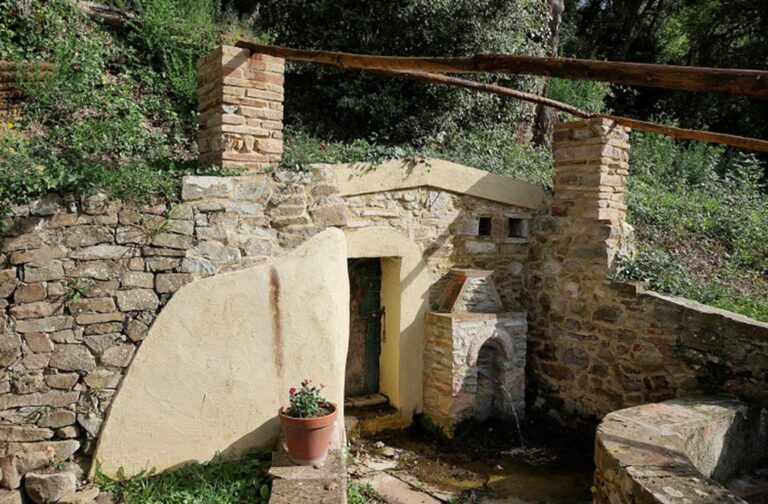
[In the photo the spring of Podere Bagnoli]
The word originates from “balneum” because “Bagnoli” is a place where the springs of water have always been numerous and of a certain consistency: the “Fonte dei Pitti,” that of “Tosi” or of “San Iacopo “and, behind it, “Capo di Monte” (m. 522), where the “Fossa di Bolgheri” is born ”(L. Bezzini, Dizionario castagnetano, Pontedera, Bandecchi and Vivaldi Editore, 1995, page 45).
The family Carnesecchi
Amongst locals it is said that a certain Valentino Carnesecchi, from Pistoia died at a young age after having initially settled in Segalari. His son Salvatore built a hut In Bagnoli , the first building close to the water source that has since allowed the irrigation of the fields that have been progressively cultivated. An autographed document, dating back to the 1800s, attests that “Salvadore of the late Valentino Carnesecchi, about thirty-seven years old, surprised by a strong fever in his hut in Bagnoli, ceased to live without Sacraments”. Years later, his son Ranieri built a house instead of the hut and later added new rooms to it.
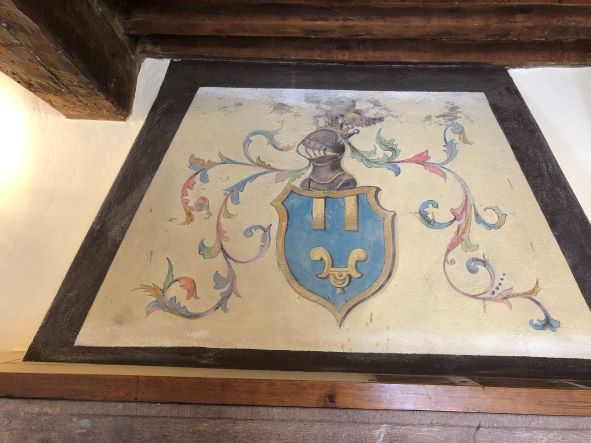
[in the Photo the fireplace of the first room built with the family crest]
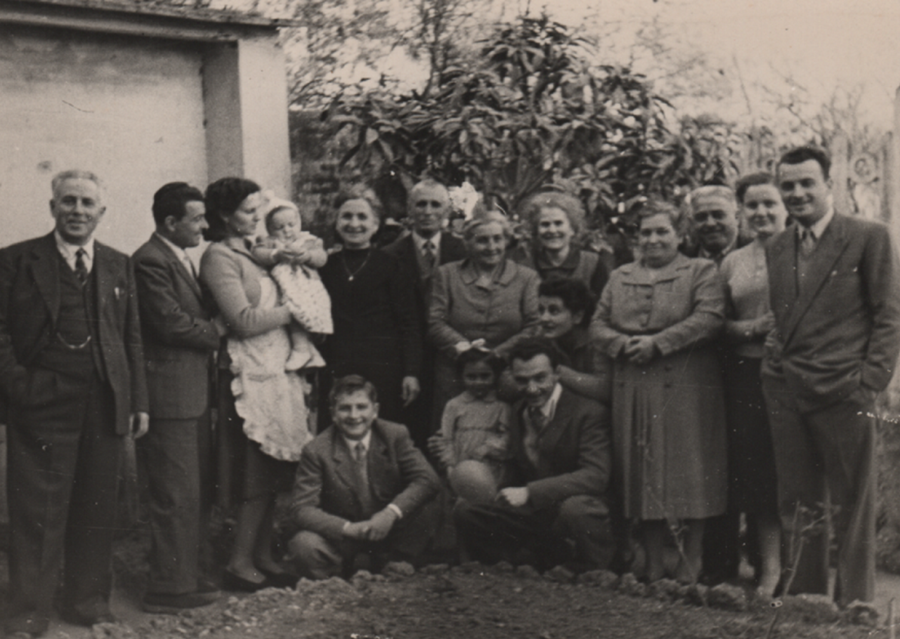
[In the photo the last inhabitants of Podere Bagnoli before the division of the assets]
Starting from the twentieth century, the Carnesecchi family, which had prospered in Bagnoli, began to invest in other areas of the county, buying properties in the nearby village of Castagneto or land and farms in the plains. Nevertheless, when a new member of the family was to be born, the mother, even if she lived elsewhere, returned to give birth in Bagnoli because that place represented a wish for prosperity and luck (this until 1940, when Clementina Carnesecchi, accompanied in a cart by the midwife, gave birth to Paolo).
In the second half of the twentieth century, the property was inherited by Adelfo Carnesecchi and, after him, to his only daughter Virginia,”Titta”. With her husband Dilvo Scateni and son Gino, Titta used to spend only the summer months in Bagnoli. Nevertheless,she loved to invite guests over, since she was famous for her culinary skills, in particular for her special recipe of the wild boar head.
In the 1990s, however, a first renovation of the buildings was needed, carried out by Giorgio Serni, akin to the family, also fascinated by the harmony of that place and by the fertility of the land, starting to cultivate small plots again. Since then the buildings have been used as a tourist reception, under the supervision of Eva Odörfer, who lived there for a long time.
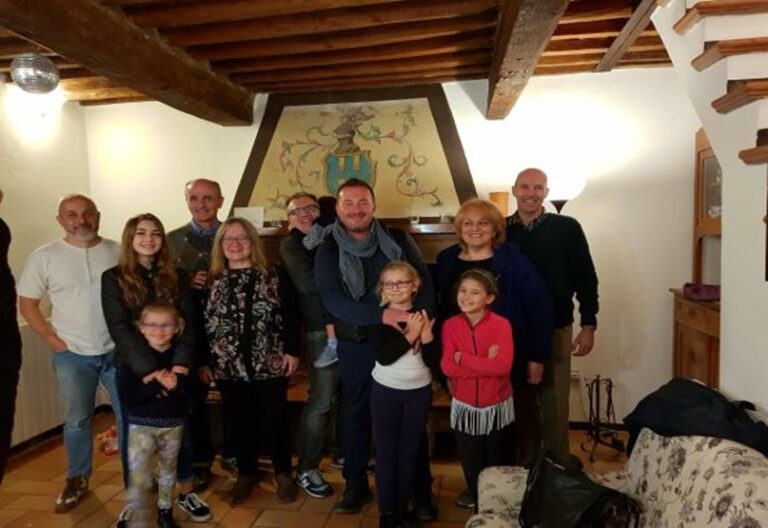
[In the photo the latest generation of the Carnesecchi, children and grandchildren of the last inhabitants of the Podere, gathered in Bagnoli in November 2018 under the family crest shown on the large fireplace of the Acanto suite].
It was the Sars-Cov2 pandemic that gave a new twist to the fate of Bagnoli: the owner Gino Scateni, in fact, decided to invest in the restoration of the structure in order to make available to guests not only a unique place for its beauty, but also a strong identity of where to discover the past of Bagnoli, and the culture of the whole Tuscan Maremma.